
A Nexure AI product · Revenue leakage detection
Find what your CRM misses
Your team talks to customers every day. Part of that conversation never reaches the CRM, and what the CRM does not know shows up in no forecast, no pipeline review and no decision.
€750 · report in 72 hours · refunded if it doesn't surface three things you didn't know
Watch it work before you talk to anyone
Under a minute with the product open: where each finding comes from, what it shows about a client, and what never reached the CRM. No mockups.
A CRM cannot tell you what it is missing
It has nothing to compare itself against: it only knows what somebody typed into it. CERUNA reads your sales team's email and calendar headers, checks them against what the CRM has on record, and names the difference. That is what actually happened and nobody logged.
We do not replace your CRM and we do not want to. Your CRM shows the data; CERUNA reads it and tells you where to look.
What it actually does
- 01
Connects read-only
To your CRM, and to your team's mail and calendar. The mailbox side is authorised once by your domain administrator: no salesperson has to create an account or click through a consent screen.
- 02
Joins the two sides
A contact's address is the only thing a mailbox and a CRM share. A message from somebody who is not in the CRM is attributed to nobody. We would rather say nothing than put a stranger's mail on one of your accounts.
- 03
Names the gap
How many conversations each client had, and how many the CRM records. Which opportunity got a reply nobody picked up. Which quote expires this week with nobody watching.
- 04
It tells you without you opening anything
At eight on Monday, in your company's own time, an email with the week. Every finding ends in something concrete: a task, a draft, a field to correct. Nothing that leaves your team runs until a person approves it.
How revenue leakage is measured
Two numbers, and neither is an estimate. Both halves of each division come from data already sitting in your systems, and both can be checked one row at a time.
- Activity Leakage Rate
- Of everything your team discussed with customers, how much left no trace in the CRM. It counts as recorded if the CRM logged something for that customer that day, the day before or the day after: writing it up the next morning is normal and should not count as leakage. Measured again every month, which is where you see it drop.
- Invisible relationships
- Companies your team exchanges mail with in both directions, several times, over weeks, that do not exist in your CRM. Not as an account, not as a contact, not as an opportunity. A CRM cannot produce this list: it logs mail from the contacts that exist, so by construction it cannot see the ones that do not.
- The client stopped replying
- You keep writing and they have not answered in weeks. This is the case that wrecks a forecast, because it reaches Friday looking healthy: there is recent activity and the record is up to date. What the CRM cannot show you is that everything moving there is being moved by you. Knowing it means separating what came in from what went out, and a CRM only holds what somebody wrote into it.
- Leads on the record with nothing opened
- Companies your own CRM marks as a lead, that your team keeps exchanging email with, and for which nobody has opened an opportunity. Your CRM can filter the first half. Crossing it with the mailbox, it cannot.
What happens after it finds something
Finding something and leaving it inside an application is not finding it. A head of sales does not open one more tool in the morning, so CERUNA goes to them.
- The Monday email
- At eight, in your company's own time, with the week's five things, the money behind them, and what moved after what it proposed before. Only to whoever runs or watches the pipeline, never to a rep. And only when there is something to say: a weekly alert that sometimes says «nothing» stops being read.
- The verdict, written into your CRM
- CERUNA leaves two fields of its own on every deal: the risk and the reason. From there you build your own workflows in the CRM you already pay for. We do not compete with its automation, we feed it.
- And what happened next
- For every action carried out, what followed in the next two weeks: a reply, a meeting, a stage change. As sequence and never as cause. Somebody answering two days after a follow-up does not prove the follow-up did it, and claiming credit would be the first lie.
And now you can ask it
What makes AI useful inside a company is not how clever it is, it is what it knows about that company. CERUNA has been reading your CRM and your mailbox for months, so the question gets answered with your data in front of it, not with what a model happens to remember.
- In plain words, about your own pipeline
- «Who has gone longest without replying?» «What could fall through this month?» From a client's record, «and this one?», and it already knows who you mean. No syntax to learn and no second tool to open.
- Every sentence links to the row it came from
- The model queries nothing. Before it is asked, CERUNA assembles the case file from stored rows and hands it over numbered, and the model may only answer by citing those numbers. If it cites something that does not exist, the answer is not shown. It is not a promise that it will not invent: it is that it cannot.
- On your own key, if you want
- You can put in your own account's key with the AI provider. Then the questions go through your account and not ours, and «does my data go through a third party's model?» is answered with «through yours». It works the same without it.
What it looks like
Screenshots of the product running on demonstration data. The live instance holds real customer names, and we are not putting those on a public page to earn your trust.
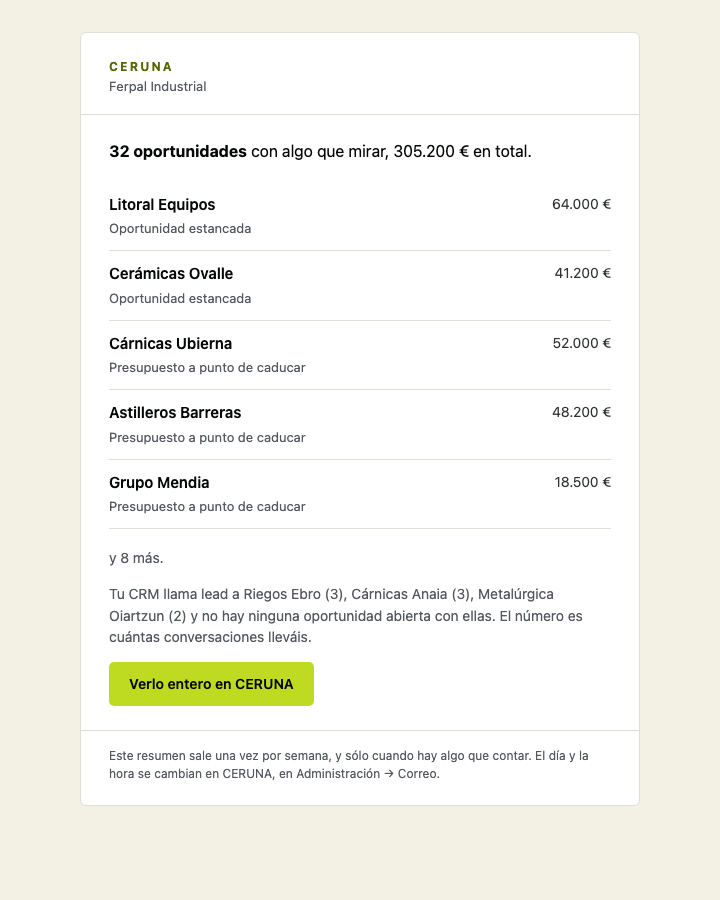
What lands on Monday
This is not a screen: it is the email, drawn by the same code that sends it. Five clients, not five alerts, and one link. The forty-row weekly summary gets archived unopened.
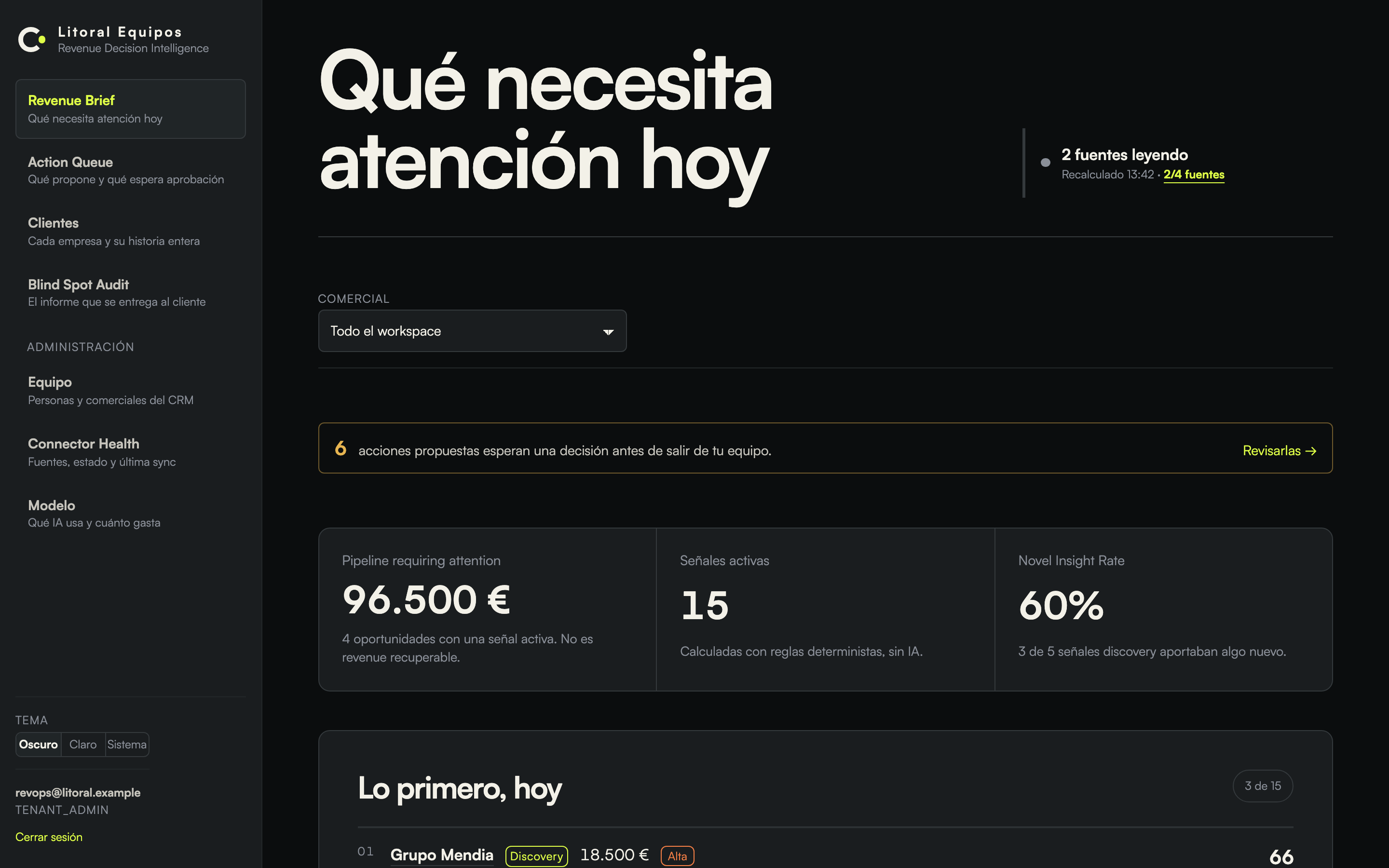
What needs attention today
Your open pipeline and, beside it, the part that carries a signal. Every opportunity in one sentence, with the arithmetic behind the score one click away. The Novel Insight Rate measures how many findings told the team something it did not know.
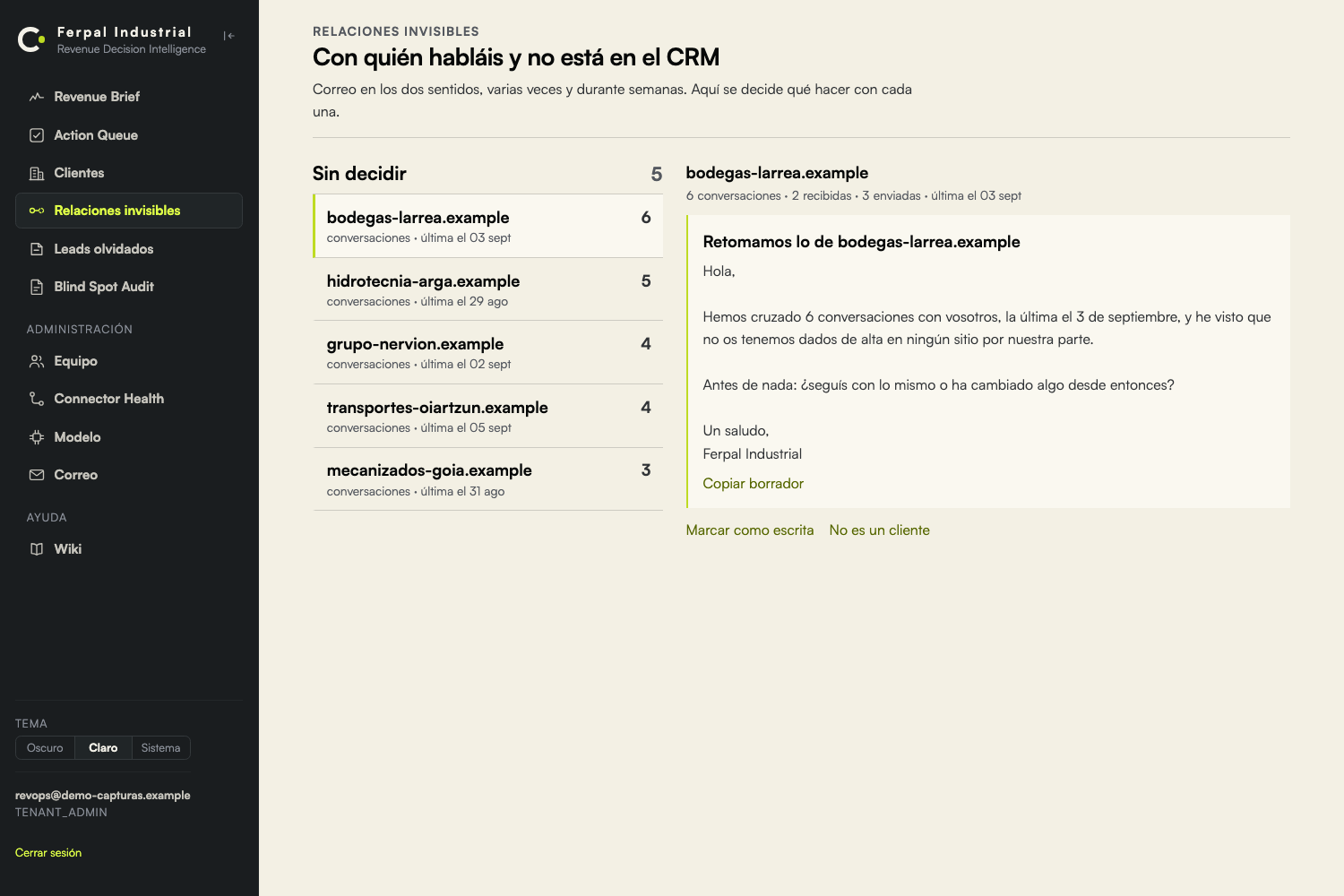
Who you talk to that is in no system
Email in both directions, several times, over weeks, with companies that exist in none of your systems. Each one comes with the message to pick the conversation back up.
Who it is not for
A team of two, where whoever runs it carries their own accounts and knows every deal by heart: there is nothing to cross-check that is not already in their head. Anyone without a CRM, because there would be nothing to compare against. And anyone already paying for a Clari or a Gong, who gets this already.
A CRM that logs email well does not close the gap: it changes it. You still have the data and there is still nobody reading all of it, and what has no record in the CRM still does not exist for it. That is what we do, across the whole domain, in one pass.
We read headers. Never the body
Who wrote to whom, and when. That is enough to know a buyer moved and the CRM does not know it. The permission we ask Google for cannot return the contents of a message. That is Google's limit, not a promise of ours, and Microsoft's works the same way.
- Read-only. CERUNA sends no mail and changes nothing in your CRM without approval.
- The calendar is read-only too: it cannot create, move or accept anything.
- Every source states on screen how far it reaches, so you can check it rather than believe it.
Where you start
Revenue Blind Spot Audit
A read-only connection to your CRM and to your team's mailboxes, and a report in three days. Every finding with its amount, its owner, and underneath it the trail of how it got there: the day you wrote, the day they answered, and how many times you have written since. All dated, so you can check it against your own CRM.
We refund the €750 if it does not surface three things you did not already know. And it comes off the pilot if you carry on.
Request the auditWe do not demo on invented data. The audit runs on your pipeline, which is the only way you would believe it.
What people ask
What can I do if my team does not update the CRM?
Not much, if the only tool is nagging. A rep does not stop logging out of laziness: logging gives them nothing back. What you can do is stop depending on them logging it. CERUNA reads what already happened in email and calendar and names the deals whose record no longer describes reality, with nobody installing anything or changing how they work.
Does HubSpot log my team's email automatically?
More than people think, and it is worth being exact. Their own documentation, updated in August 2026, says that «Log all emails (from known contacts)» is the default option on every account: it logs mail a salesperson sends from outside the CRM, mobile included, as long as the recipient is already a contact. So the line «your CRM is not capturing your team's activity» is not true of a portal configured the way they ship today, and we do not use it. What stays true is structural: a CRM cannot log activity against records that do not exist. The company you have been talking to for three months that nobody ever created is invisible by construction, not by configuration.
How do I know whether my sales forecast is reliable?
By looking at what it is made of. A forecast comes from close dates and stages the team types in, so it is worth exactly what that typing is worth. The useful question is not «how much will we close?» but «of these deals, how many have an up-to-date record?». That one can be measured, and it is what the audit does.
Do you have to read our email?
We read headers: sender, recipients, date and subject. The permission we request from Google does not allow a message body to be returned, so it is not a promise you have to take on trust: it is the provider's own restriction. Microsoft works the same way with Mail.ReadBasic.
Does every salesperson have to sign in?
No, if you use Google Workspace or Microsoft 365. Your administrator authorises it once for the whole domain and no salesperson sees anything. With personal mail accounts each person would have to authorise it themselves.
Does it replace our CRM?
No. CERUNA sits on top of the CRM you already have and its job is to point at what that CRM does not know. When it proposes something, it lands as a task or a note inside your CRM, not somewhere else nobody looks.
Which CRMs do you support?
HubSpot and Minerva work today. Salesforce, Pipedrive and Brevo are in the catalogue. And we are building the billing family, starting with Holded: crossing what the CRM calls sold against what was actually invoiced. They get built ahead, not when a customer asks.
What if it finds nothing?
That is a result, and we will say so. If your CRM already captures everything your team talks about, the audit costs you nothing: we refund the €750.
Start by knowing how much is getting away
A read-only connection, three days, and a report you can check against your own CRM.
Let's talkWhat we measured before selling anything
We wrote it down first. Each one carries the filters so you can check it in your own CRM.
- Does HubSpot log email automatically?Their documentation says logging everything is the default. What it cannot log is what has no record.
- Why your team does not update the CRMNot laziness: logging gives nothing back to the person logging. Which is why pushing fails.
- Whether your sales forecast is reliableThree counts you can run this week, each with the HubSpot filter that reproduces it.
- Five things your CRM already knowsFive lists your own filters give you free, and the two it cannot give you at all.
The rest of Nexure AI
CERUNA is one of our products. We build and run software for companies that need their systems to talk to each other.